The Forgotten Side of the Apprenticeship Triangle
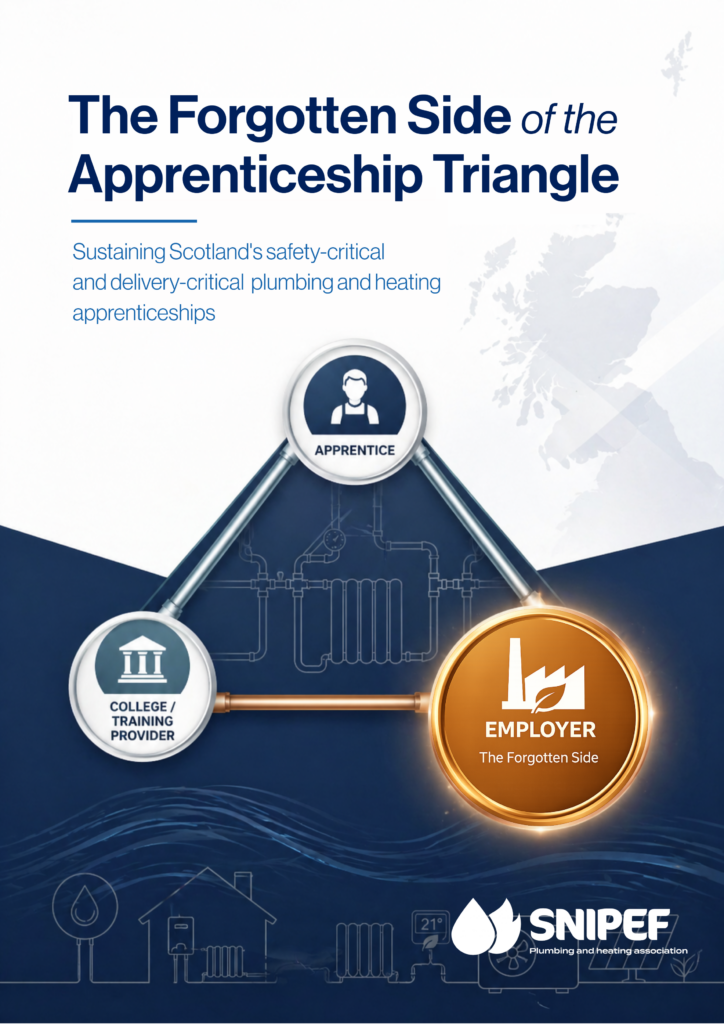
Scotland’s plumbing and heating employers are committed to training the next generation of skilled professionals. However, rising costs, increasing financial risks and the practical demands of delivering apprenticeships are placing that commitment under growing pressure.
SNIPEF’s report, The Forgotten Side of the Apprenticeship Triangle, examines the challenges facing employers who invest in apprenticeships and considers what needs to change to protect the future of skills development in Scotland.
Drawing on a national employer survey and five regional working groups, the report brings together the experiences and perspectives of more than 240 plumbing and heating employers across Scotland. Its findings and recommendations have also attracted wider support from businesses across the profession.
The research highlights the often overlooked contribution employers make to the apprenticeship system. While apprentices and training providers receive considerable attention in discussions about skills funding, employers carry substantial responsibilities for wages, supervision, training and workplace development throughout the four-year apprenticeship.
Despite their continued commitment, many employers report that the financial burden and risks associated with training are making it increasingly difficult to recruit apprentices and sustain investment in the future workforce.
Four recommendations for change
The report calls for action in four key areas:
- Targeted financial assistance: Introduce support for employers delivering apprenticeships, particularly towards wages during mandatory college attendance and the costs of supervision in the early years of training.
- Recognition of apprentice wage rates: Ensure nationally agreed apprentice wage rates are recognised within local, regional and national grants and employer support schemes.
- Fairer public procurement: Require public contracts to explicitly cost and fund apprenticeship commitments imposed through social value or community benefit conditions.
- Flexible training pathways: Examine accredited routes that recognise relevant existing skills and experience while maintaining established standards of competence and safety.
Building a sustainable future for apprenticeships
The report is not a criticism of the apprenticeship model. It recognises the value of Scotland’s established four-year training framework and the commitment of employers, apprentices and colleges to developing a highly skilled workforce.
Instead, it makes the case for a more balanced approach to apprenticeship policy, one that recognises employers as an essential and equal part of the apprenticeship triangle.
Without employers willing and able to recruit, train and invest in apprentices, Scotland cannot develop the skilled workforce needed to meet its future housing, infrastructure and energy ambitions.
SNIPEF is calling on the Scottish Government, public agencies and industry partners to work together to address these challenges and ensure that apprenticeships remain a viable and attractive investment for businesses of all sizes.